Operation Venezia Battle of Gazala, North Africa — 1942
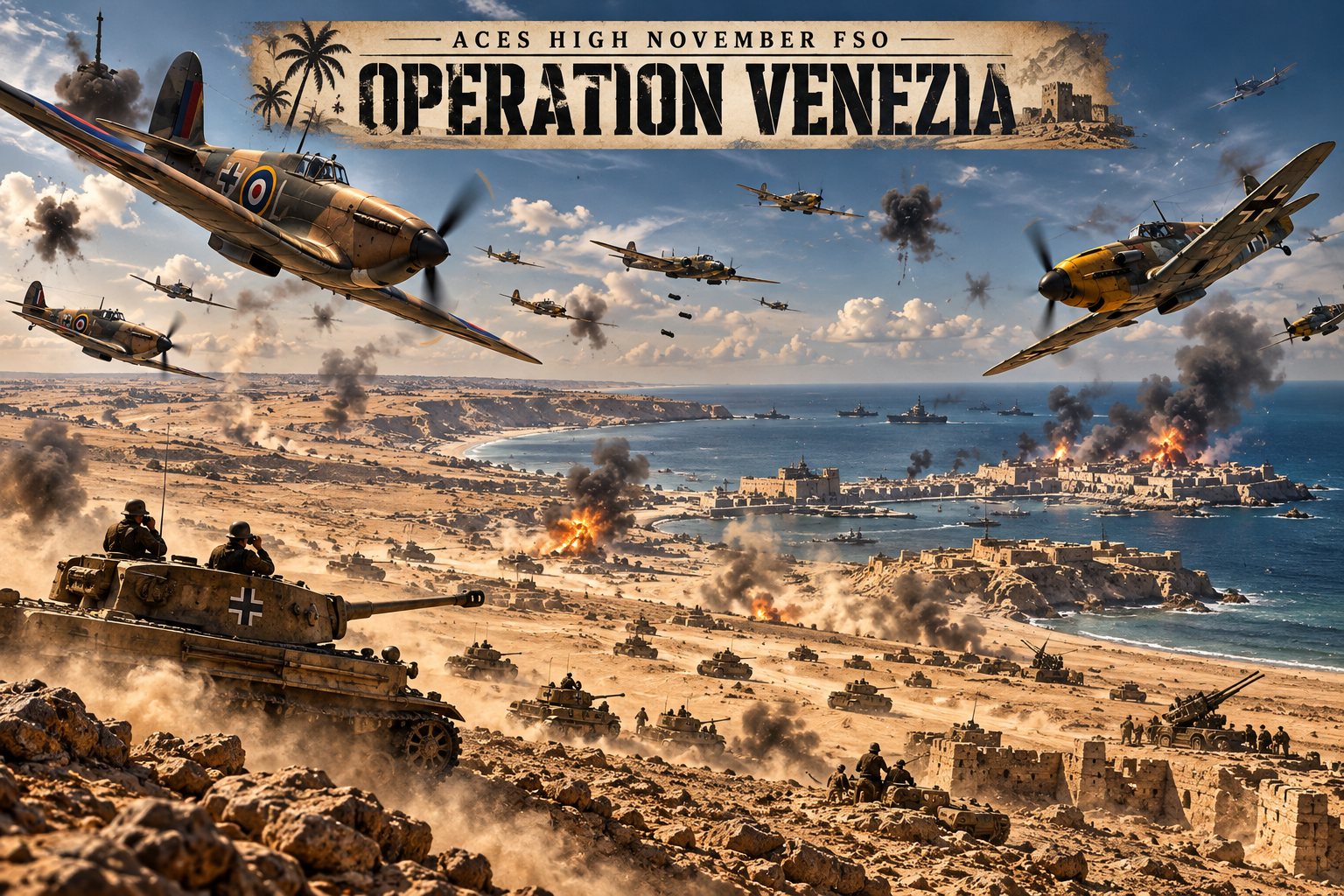
NOVEMBER 2026 FSO — OPERATION VENEZIA
The Battle of Gazala | North Africa | May 26 – June 21, 1942
Terrain: Egypt
Campaign: Three Frames
Attacking Forces: Axis
Defending Forces: Allies
Historical Background
By the spring of 1942, the war in North Africa had reached a critical turning point.
Following months of fighting across the deserts of Libya, British Commonwealth forces had established a defensive line stretching southward from the coastal town of Gazala, approximately 40 miles west of Tobruk. This defensive system consisted of fortified positions, extensive minefields, and heavily defended strongpoints intended to halt any renewed Axis advance toward Egypt.
Behind these defenses stood Tobruk, a strategically vital port whose capture would significantly improve Axis supply operations and threaten the British position in Egypt.
Opposing the British Eighth Army was Generaloberst Erwin Rommel's Panzerarmee Afrika, composed of German and Italian formations. Despite persistent shortages of fuel, ammunition, and supplies, Rommel prepared an ambitious offensive intended to break the Gazala Line, defeat the Allied armored forces, and capture Tobruk.
On the night of May 26, 1942, Rommel launched Operation Venezia.
Rather than attacking the strongest Allied defenses head-on, Axis armored formations swept southward around the Gazala Line before turning north and east into the British rear. What followed was a series of violent armored engagements, desperate defensive actions, and fierce air battles above the desert.
The offensive soon developed into what became known as the Battle of the Cauldron, as Axis forces fought to maintain their positions while surrounded by Allied formations and threatened by dwindling supplies.
After weeks of fighting, the Allied defensive line collapsed. On June 21, 1942, Tobruk fell to Axis forces, along with substantial quantities of equipment and supplies.
The victory marked one of Rommel's greatest successes in North Africa and opened the way for the subsequent Axis advance toward El Alamein.
November FSO Campaign Overview
This November, Aces High FSO will recreate the Axis offensive through three progressively escalating frames, beginning with the opening attack against the Gazala Line and culminating in the battle for Tobruk.
Unlike campaigns in which the attacking side alternates between frames, the Axis will remain on the offensive for the entire tour.
Frame 1 — Operation Venezia: Break the Gazala Line
May 26–27, 1942
Axis forces launch their opening offensive against Allied defensive positions.
The Luftwaffe and Regia Aeronautica will attempt to establish air superiority and support the initial attacks, while Allied fighter forces scramble to defend the line.
Frame 2 — The Cauldron
Late May – Early June 1942
The fighting intensifies as Axis formations press deeper into Allied territory.
Both sides must contest the skies above the desert as the Axis attempts to break the remaining Allied defenses and open the road to Tobruk.
Frame 3 — The Fall of Tobruk
June 20–21, 1942
The campaign reaches its conclusion with an all-out Axis assault on Tobruk.
Unlike the previous frames, Frame 3 will feature a combined-arms battle centered on the capture or defense of an airfield.
Axis ground forces will attempt to capture Tobruk while Allied defenders fight to hold the base.
The battle will feature:
-
Panzer IVs — Axis armored assault
-
M4 Shermans — Allied armored defense
-
Anti-aircraft vehicles — Mobile air defense for both sides
-
Anti-tank aircraft — Dedicated aircraft supporting the ground battle
Air superiority, ground-attack coordination, and the survival of armored forces will all play a role in determining the outcome.
The Sherman is included as a gameplay choice; it did not participate in the historical Battle of Gazala.
Aircraft Assignments — Frames 1 & 2
Initial Launch Aircraft
ALLIED FORCES
| Aircraft | Allocation |
|---|---|
| Spitfire Mk V | Maximum 12 |
| Hurricane Mk IIC | Maximum 6 |
| P-40E Kittyhawk | No minimum or maximum |
AXIS FORCES
| Aircraft | Allocation |
|---|---|
| Bf 109F-4 | Maximum 12 |
| Macchi C.202 Folgore | No minimum or maximum |
| Ju 88A-4 | Minimum 8 pilots |
Secondary Aircraft
ALLIED FORCES
-
Hurricane Mk I
-
P-40C Tomahawk
AXIS FORCES
-
Bf 109E-4
-
Ju 87 Stuka
Aircraft Availability and Sortie Restrictions
Each frame will feature two separate launch periods, with an initial aircraft allocation available at the beginning of each hour.
Initial Launch — T+0
All aircraft listed under the initial launch allocation will be available.
Secondary Launch — T+5
Five minutes after the opening launch, initial aircraft will be disabled for additional sorties.
Pilots may continue flying their initial aircraft for as long as they remain airborne, but subsequent sorties must be flown using the secondary aircraft selection.
Second Hour — T+65
At the beginning of Hour 2, initial aircraft will become available again, providing each pilot another opportunity to launch the primary aircraft selection.
Secondary Launch — T+70
The secondary aircraft restrictions return for the remainder of the frame.
The intent is to make aircraft preservation an important factor while allowing the fighting to evolve as the battle progresses.
Campaign Objectives
The three frames will follow the historical progression of the Gazala campaign:
Frame 1: Break the Gazala Line.
Frame 2: Fight through the Cauldron and push toward Tobruk.
Frame 3: Capture or defend Tobruk in a combined air-and-ground battle.
Exact target assignments, airspawn locations, scoring, and Frame 3 vehicle restrictions will be published with the individual frame orders.
The deserts of North Africa await.
Salute!
Rider
JG11 Sonderstaffel
November FSO Campaign Manager